

The adaptation of Pearl S. Buck’s, The Good Earth, follows Wang Lung and O-Lan as they begin their newlywed lives as lowly farmers in early 20th century rural China. They work hard, save, and buy up more land. Famine forces them to struggle with starvation, riots, and the possibility of losing everything the hold dear, their land and their children. They rise from the ashes by the determination of O-Lan. Only to have their relationship deteriorate with prosperity and wealth. The Good Earth reminds us to hold on and cherish the things that are most important.
The story conveyed in The Good Earth is powerful. The impact is greatly diminished by casting white actors to play the roles.
Buck’s Influential Novel
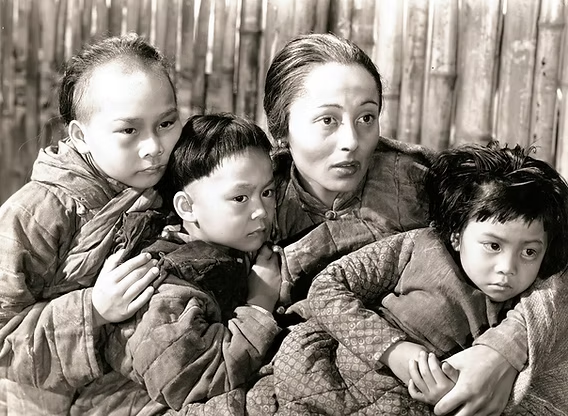
Pearl S. Buck’s historical fiction novel, The Good Earth, was a sensation. Resulting in a best seller status, a Pulitzer prize in 1932, and the Nobel prize for Literature in 1938. The story follows Wang Lung (Muni), a poor farmer in rural china, and his wife O-Lan (Rainer). The epic begins from the day of his marriage to O-Lan and follows them through sickness and health, poverty and wealth, peace and turmoil, culminating in the death of O-Lan.
The humble beginnings of these characters are filled with hard work, appreciation for what they have, and dutiful attention to not take what they have for granted. Their hard work results in prosperity that allows them to expand their farm and provide for their three children as well as Wang’s live-in father (Grapewin).
As their wealth grows, so too does the impending famine. Once they are struck by famine they persevere, resorting to eating dirt in order to keep their bellies full. Defiantly, they refuse to sell their land and end up migrating to the big city where they are caught up in revolution and riots. They are saved when O-Lan is able to loot some gems from a riot and they return home richer than ever.
At the start, it appears that this film is going to be about Wang. It becomes clear that the story’s protagonist is actually O-Lan. The resilient, ever-steady, and dutiful (to a fault) wife and mother. She sacrifices everything for her families survival and it is not until the very end that she gets a a fraction of the praise and recognition she deserves.
A Cast in Yellow Face

It seems ridiculous to have Muni and Rainer star as Chinese characters. I know the concept was typical of the era, and for a long time to come. However, this cast was about as white as it gets. The only cast members of Chinese, or otherwise Asian descent, were a handful of secondary characters. I am glad that the studio was able to at least get a couple people suited for the roles.
Muni & Rainer
I expected Muni to be the standout player in the film. Typically, his presence is center stage and his character is by far the main focus. Muni stands out, even when he gets lost behind the makeup, like in The Story of Louis Pasteur. I was surprised to see a deviation in this film, than in the many other that preceded it.
When we are first introduced to Wang, we are shown a giddy and uneducated man. Muni’s characterization of Wang, early on, is very similar to his portrayal of Joe Radek in Black Fury. A well-intentioned and naive youth accentuated to be over the top in order to maximize the change in character by the end of the story. The combination of Muni’s makeup, as a Chinese farmer, as well as his over the top performance early on, made me think this was going to be the beginning of the end of Muni’s run.
The eccentric portrayal of Wang early on quickly fades and he becomes more palatable. No longer bumbling and giddy, Wang shows that he can and will work hard to succeed. Muni turns the goof level down a few notches, so to speak.
Rainer on the other hand, stays reserved and steady with her portrayal of O-Lan. We see the sadness in her eyes being held back in order to be strong, the joy being held back in order to maintain composure. Rainer embodied a character that is trapped in a place and time where she is not allowed to exist for herself, only for others.

Karl Freund
The cinematographer on The Good Earth was the legendary Karl Freund. Freund revolutionized the use of cameras in films in the 1920’s, when he took the camera off the tripod and established the unchained camera technique, notably in the film Der letzte Mann (The Last Laugh, 1924).
The Good Earth was captured through a variety of settings, small living quarters, expansive farm lands, illustrious mansions, city streets, and migrant camp towns. These settings as the backdrops were fully captured and enhanced by Freund’s work behind the camera. Freund was rewarded for his work on The Good Earth, earning him an Oscar for Best Cinematography at the 10th Academy Award’s.
Directed by: Sidney Franklin
Cinematography: Karl Freund
Based on the Novel, The Good Earth, by: Pearl S. Buck
Screenplay by: Talbot Jennings, Tess Slesinger, & Claudine West
Editing By: Basil Wrangell
Starring: Paul Muni, Luise Rainer, Charley Grapewin, Tilly Losch, Walter Connolly, Soo Yong, Keye Luke, Roland Lui, &
Runtime: 2h 18m
Genre: Drama, Romance
Production by: Metro-Goldwyn-Mayer
Distributed by: Loew’s, Inc.
Discover more from CasualViewer
Subscribe to get the latest posts sent to your email.
